
How to Reduce Ticks in Your Yard and Protect Your Family From Lyme Disease
Connecticut has one of the highest Lyme disease rates in the country—and most infections happen right in your own backyard. The good news? You can significantly reduce your family's risk with the right approach to tick management.
Quick Facts About Tick Prevention
- Yard modifications matter: Simple landscaping changes can reduce tick populations by 50% or more in high-use areas of your property.
- Timing is critical: Treat your yard before peak tick season (April through September) for maximum protection against Lyme disease.
- Layered protection works best: Combining landscape management with professional treatments provides the most effective tick control.
Can You Really Reduce Ticks in Your Yard?
Yes—reducing tick populations in your yard is achievable through a combination of landscape modifications, targeted treatments, and ongoing maintenance. According to the Connecticut Agricultural Experiment Station, "fewer ticks have been found on well-maintained lawns, except on areas adjacent to woodlands, stonewalls, or heavy groundcover and ornamental vegetation" (Stafford). By making your property less hospitable to ticks and their hosts, you can create safer outdoor spaces for your family.
In our 40 years serving Connecticut homeowners, we've seen firsthand how proper tick management transforms yards from high-risk zones into spaces where families can play, garden, and relax without constant worry. This isn't about eliminating every tick—it's about dramatically reducing your exposure in the areas you use most.
Why Connecticut Homeowners Face Higher Lyme Disease Risk
Lyme disease was literally discovered here—named after the town of Lyme, Connecticut, where cases were first identified in 1975. Today, the Connecticut Department of Public Health reports that "since 1995, an average of 2,718 cases (range 1,348 to 4,631) have been reported to the DPH annually" ("Lyme Disease"). That makes Connecticut consistently among the top states for Lyme disease incidence.
The blacklegged tick (also called the deer tick) is responsible for transmitting the Lyme disease bacteria, Borrelia burgdorferi. These ticks thrive in Connecticut's wooded, suburban landscapes—exactly the kind of property many of us call home. Research from Dartmouth found that roughly half of all adult blacklegged ticks in the Northeast carry Lyme disease bacteria, with up to 25% of harder-to-detect nymph-stage ticks also infected.
What makes this especially concerning is where exposure typically occurs. Studies indicate that approximately 75% of Lyme disease cases result from tick bites that happen in residential yards—not hiking trails or deep woods. Your property's edge where lawn meets forest, your stone walls, and shaded garden beds are prime tick habitat.
How to Make Your Yard Less Attractive to Ticks
Creating a tick-safe yard isn't about transforming your entire property. Instead, focus your efforts on the areas where your family spends the most time. The CDC and Connecticut Agricultural Experiment Station recommend an integrated approach that addresses tick habitat, their animal hosts, and direct tick control.
Step 1: Create a Tick-Safe Zone Around High-Use Areas
Start by identifying where your family actually spends time outdoors—patios, play areas, gardens, and pathways. Your goal is to create a buffer between these spaces and tick-heavy zones like woodlands and overgrown areas.
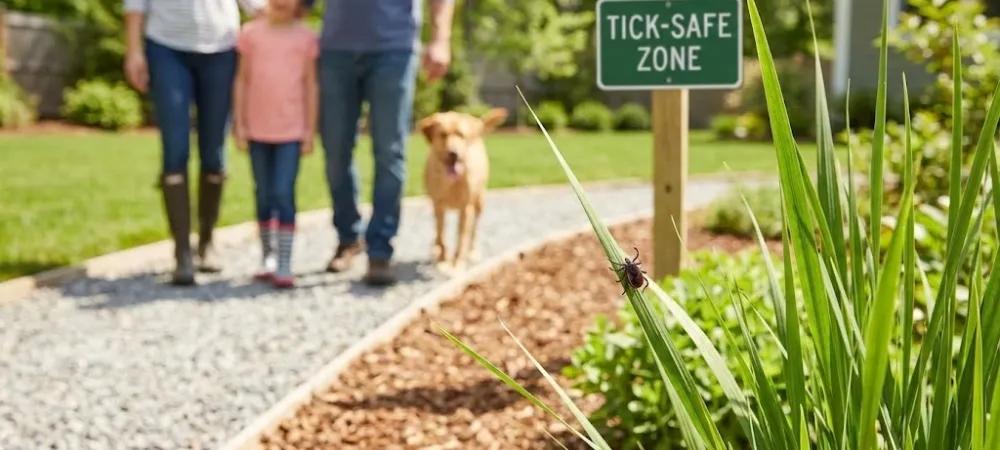
The CDC recommends placing "a 3-ft wide barrier of wood chips or gravel between lawns and wooded areas to restrict tick migration into recreational areas" ("Preventing Tick Bites"). This simple barrier creates a dry, sunny zone that ticks avoid crossing. Keep this barrier at least 3 inches deep and maintain it throughout the season.
Step 2: Modify Your Landscape to Discourage Tick Survival
Ticks require moisture and shade to survive. By reducing these conditions in your yard's frequently used areas, you make the environment hostile to ticks. Focus on these modifications:
- Mow regularly: Keep grass under 3 inches tall in play areas and along pathways. Short grass dries faster and gets more sun exposure.
- Remove leaf litter: Clear leaves from lawns, garden beds, and around foundations—especially in spring before tick season peaks.
- Trim back vegetation: Prune shrubs and low-hanging branches to increase sunlight and air circulation in areas where people walk or gather.
- Relocate woodpiles: Stack firewood neatly in a dry area away from your home. Woodpiles attract mice, which are the primary reservoir for Lyme disease bacteria.
- Clear brush and weeds: Remove overgrown vegetation along fences, stonewalls, and property edges where ticks concentrate.
Step 3: Manage Wildlife That Carry Ticks
Mice and deer are the primary hosts for blacklegged ticks. While eliminating them entirely isn't realistic, you can discourage their presence near your home:
- Remove bird feeders during spring and summer (they attract rodents)
- Seal gaps in stonewalls and around sheds where mice nest
- Consider deer-resistant plantings or fencing if deer browse is heavy
- Keep garbage secured and compost bins away from living areas
Step 4: Position Play Equipment and Furniture Wisely
Keep playground equipment, outdoor furniture, and patios in sunny, well-maintained areas away from yard edges and wooded borders. The CDC specifically recommends keeping "playground equipment, decks, and patios away from yard edges and trees" ("Preventing Tick Bites"). This simple positioning change reduces tick encounters during everyday activities.
Tick Treatment Options: DIY vs. Professional
Beyond landscape modifications, direct tick control treatments can further reduce tick populations. Here's how the options compare for Connecticut properties.
DIY Tick Control Methods
Homeowners can apply EPA-registered acaricides (tick-killing pesticides) to their yards, typically as granular or liquid formulations. These products work best when applied to specific tick-prone zones rather than entire properties.
Pros: Lower upfront cost; homeowner control over timing and products.
Cons: Requires proper equipment and technique; may miss critical areas; effectiveness varies significantly based on application quality; safety concerns around pets and children if not applied correctly.
Tick tubes—cardboard tubes containing permethrin-treated cotton—offer another DIY option. Mice collect the cotton for nesting material, which kills ticks on the mice. These work best when deployed strategically around your property's perimeter in late spring and late summer.
Professional Tick Treatments
Licensed pest control companies apply targeted treatments to high-risk zones on your property, typically using professional-grade products and equipment. In our experience, most Connecticut properties benefit from treatments in mid-spring (targeting nymphs) and early fall (targeting adults).
Pros: Professional-grade products; trained application targeting correct areas; treatments designed to be safe for families and pets; ongoing monitoring and retreatment if needed.
Cons: Higher cost than DIY; requires scheduling.
Research cited by the Connecticut Agricultural Experiment Station indicates that "a single springtime application of an acaracide can greatly reduce the number of ticks in your yard" (Stafford). However, combining professional treatments with landscape modifications provides the most significant and lasting reduction in tick populations.
Personal Protection Tips That Work
Even with excellent yard management, some tick exposure is inevitable—especially when hiking, gardening in shaded areas, or visiting other properties. These personal protection measures provide an additional layer of defense:
- Conduct daily tick checks: Check your entire body after outdoor activities, paying special attention to hidden areas like armpits, groin, and behind ears. Prompt removal is crucial—ticks must remain attached for 24-48 hours before transmitting Lyme disease bacteria.
- Shower within two hours: Bathing soon after coming indoors helps wash off unattached ticks and makes it easier to find any that have attached.
- Tumble dry clothing on high heat: Ten minutes in a hot dryer kills ticks on clothing. Do this before washing, as cold or warm water won't kill them.
- Use EPA-registered repellents: Products containing DEET (20-30%), picaridin, or IR3535 repel ticks on skin. Permethrin-treated clothing provides additional protection.
- Protect your pets: Talk to your veterinarian about tick prevention products for dogs and cats. Pets can carry ticks into your home, where they may transfer to family members.
When to Call a Professional for Tick Control
While landscape modifications help significantly, certain situations call for professional tick and mosquito control:
- Properties bordering woods or wetlands: These high-risk locations benefit most from professional barrier treatments.
- Previous tick-borne illness: If anyone in your household has contracted Lyme disease or another tick-borne illness, aggressive tick reduction becomes a priority.
- Young children or elderly family members: Households with vulnerable family members may want the added assurance of professional treatments.
- Heavy deer or rodent activity: Properties with significant wildlife pressure often need professional-grade solutions.
- Large or complex landscapes: Properties with extensive wooded borders, stonewalls, or multiple shade gardens are difficult to protect with DIY methods alone.
At ProfExt Pest Control, our tick and mosquito control services include thorough property inspections to identify active pest zones and potential breeding grounds. We apply targeted treatments using family-friendly products that are tough on ticks but safe for children and pets. Our seasonal approach addresses ticks at different life stages for year-round protection.
Take Back Your Yard This Season
Protecting your family from Lyme disease doesn't require turning your property into a fortress. Strategic landscape modifications, smart personal protection habits, and professional treatments when needed can dramatically reduce your risk while letting you enjoy Connecticut's beautiful outdoor seasons.
Don't wait until tick season is in full swing. The best time to implement tick control measures is before populations peak in late spring. Whether you need a professional assessment of your property's tick risk zones or want to schedule seasonal treatments, ProfExt Pest Control is here to help.
Contact us today for a free quote and learn how our 40 years of experience can help make your yard safer for your family.
Sources
- "Lyme Disease." Connecticut Department of Public Health.
- "Preventing Tick Bites." Centers for Disease Control and Prevention, 14 May 2025.
- Stafford, Kirby C. III. Tick Management Handbook: An Integrated Guide for Homeowners, Pest Control Operators, and Public Health Officials for the Prevention of Tick-Associated Disease. Revised ed., Connecticut Agricultural Experiment Station, 2007.